

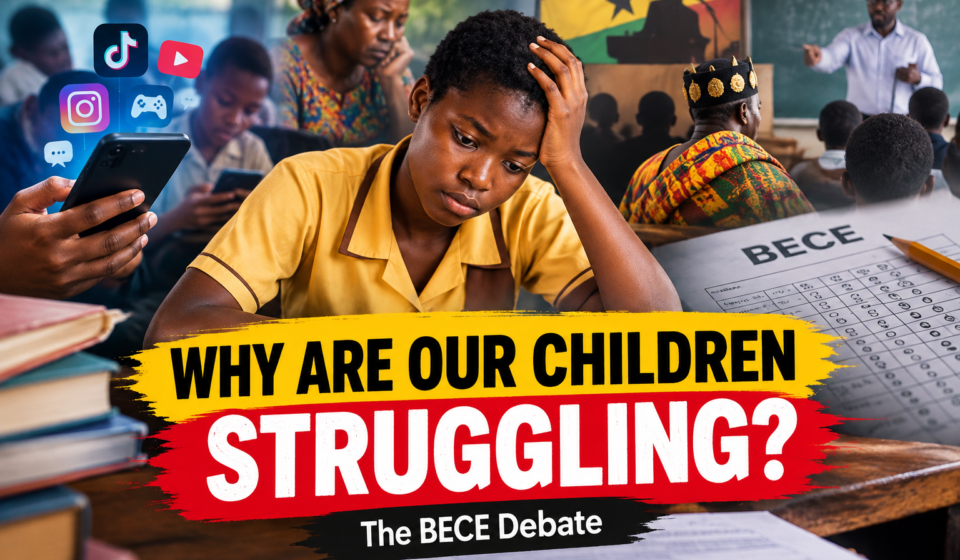
Why Are Ghanaian Children Performing Poorly in the BECE?
The release of the 2026 Basic Education Certificate Examination (BECE) results has triggered an important conversation across Ghana.
Parents are worried. Teachers are concerned. Schools are asking questions. Politicians are responding. And perhaps most importantly, Ghanaians are asking a difficult question:
Why are some of our children struggling academically?
The question became the subject of a discussion on Connect FM, where listeners shared their views on some of the possible reasons behind the disappointing performances.
Among the concerns raised were children spending too much time on their phones, weak parental supervision, the politicisation of education, and the tendency to blame traditional leaders for problems that may require action from the entire community.
But the debate should not end there.
The performance of Ghanaian children cannot reasonably be blamed on one factor. It is the result of a complicated combination of what happens at home, in schools, in communities, online and within the wider education system.
So, what could be going wrong?
1. Are smartphones and social media distracting our children?
This was one of the strongest concerns raised by listeners.
The smartphone has become part of everyday life for many Ghanaian children. A phone can provide access to educational materials, dictionaries, tutorials and online courses.
But the same device can also become a powerful distraction.
A child who spends several hours scrolling through TikTok, watching YouTube videos, playing games or chatting on social media may have considerably less time and concentration available for reading, revision and homework.
The problem is not necessarily the existence of the phone.
The problem is how it is being used.
A smartphone can be a classroom in a child’s hand or a distraction in a child’s hand.
That means parents and schools have to move beyond simply saying, “Phones are bad.”
The real question should be:
Who is controlling the phone — the child or the child’s environment?
2. The reading culture problem
There is another question we should ask: How much are our children actually reading?
Reading for an examination is different from reading a WhatsApp message or watching a five-minute video.
A child may know how to operate a smartphone perfectly but struggle to read a long passage, understand it and explain what it means.
That becomes particularly important in subjects where students must interpret questions carefully.
If a child does not develop a strong reading habit from the early years, the problem can eventually show up in English Language, Mathematics, Science and even Social Studies.
This is not simply an examination problem.
It is a literacy problem.
And it requires parents to create homes where reading is normal — not something that happens only when BECE is approaching.
3. Are parents doing enough?
This is perhaps one of the most uncomfortable parts of the conversation.
It is easy to blame teachers.
It is easy to blame the government.
It is easy to blame WAEC.
It is easy to blame smartphones.
But parents also have a responsibility.
A child does not become academically successful simply because he or she has been enrolled in a good school.
Parents need to know what their children are studying.
They need to check homework.
They need to speak with teachers.
They need to know who their children’s friends are.
They need to understand how much time their children spend online.
And they need to create an environment where education is taken seriously.
A parent who only asks, “What did you get in your exam?” after the results are released may already be asking the question too late.
The better question is:
“How are you performing throughout the year?”
4. But can we blame parents alone?
No.
Many Ghanaian parents are working extremely hard to provide for their families.
Some leave home early in the morning and return late at night.
Some are traders, drivers, farmers, artisans, nurses, teachers, security officers and professionals working long hours.
Some parents may want to supervise their children’s education but simply do not have enough time or resources.
This is why the conversation about parenting must be balanced.
Parents have responsibilities, but society must also recognise the economic pressures that make effective supervision difficult for many families.
5. What about teachers?
Teachers cannot escape this conversation either.
A teacher can have a tremendous impact on a child’s academic future.
A dedicated teacher can identify a struggling child early, provide extra support and help build confidence.
But Ghana also has teachers working under difficult circumstances.
Large class sizes, limited teaching materials, administrative demands and other challenges can make it difficult to give every child individual attention.
Therefore, asking whether teachers are doing enough is legitimate.
But so is asking:
Are we giving teachers the conditions they need to succeed?
If the answer is no, then improving results requires more than blaming teachers.
6. Are schools preparing students for examinations or for learning?
Another issue worth examining is the difference between learning and examination preparation.
Some schools can become heavily focused on getting students to pass examinations.
Students are drilled with past questions, memorisation techniques and examination strategies.
Those things can be useful.
But a child who memorises answers without understanding the underlying concepts may struggle when the question is presented differently.
The ultimate goal of basic education should not simply be to produce children who can pass BECE.
It should produce children who can read, reason, communicate, solve problems and apply knowledge.
7. Examination malpractice may have hidden the problem
This is one of the most significant developments surrounding the 2026 results.
President John Dramani Mahama has said tighter invigilation measures helped reduce mass examination malpractice and unauthorised assistance, arguing that the results therefore provide a more accurate picture of students’ academic abilities.
If this assessment is correct, then the difficult results may be telling Ghana something uncomfortable.
Perhaps some children were progressing through the education system with grades that did not accurately represent their actual academic ability.
That raises a bigger question:
Were we celebrating examination results without asking how those results were obtained?
If cheating had previously helped some candidates obtain better grades, stronger examination supervision would naturally expose gaps that had been hidden.
That is painful in the short term.
But academically, it may also be an opportunity.
A genuine result gives schools and parents a clearer picture of where a child needs help.
8. But what about concerns over BECE marking?
This is another side of the debate that cannot be ignored.
Following the release of the 2026 results, the Ghana National Association of Private Schools (GNAPS) called for an urgent audit, citing alleged discrepancies in some candidates’ results.
The association reported cases involving grades allegedly appearing for subjects candidates did not take and results that did not appear consistent with students’ previous academic records. GNAPS called for the affected results to be audited and reconciled.
These are allegations, not established findings.
WAEC has also pushed back against some of the concerns surrounding the results and explained that BECE grading is not simply a matter of comparing a student’s marks with classmates.
According to WAEC’s Head of Public Affairs, candidates are assessed against the performance of the national cohort, which numbered more than 620,000 candidates.
This distinction matters.
A child can be the best student in a class and still receive a grade that surprises the parents because the BECE assessment operates on a national scale.
Therefore, the debate should separate three different issues:
student performance, the BECE grading system and possible administrative errors.
They are not the same thing.
9. Is education being used for political battles?
This was another concern raised by Connect FM listeners.
Education is one of the most politically sensitive issues in Ghana.
Every government wants to demonstrate what it has achieved.
One administration introduces a policy.
Another changes it.
Political parties defend their records.
Opposition parties criticise them.
And sometimes education becomes part of the political contest rather than a long-term national project.
But children do not experience education in four-year political cycles.
A child entering primary school today may spend more than a decade moving through Ghana’s education system.
That means education policy needs continuity.
Ghana needs governments to be able to disagree politically while agreeing on the fundamentals:
children must learn, teachers must be supported, schools must be properly equipped and examinations must be credible.
Education should be treated as a national project, not simply a political trophy.
10. Should we blame traditional leaders?
Traditional leaders also came up during the Connect FM discussion.
There is certainly a role for chiefs, queen mothers and community leaders.
Traditional leaders can influence parents, mobilise communities, support schools and encourage children to take education seriously.
In some communities, a chief can gather parents and stakeholders more effectively than a government official can.
But blaming chiefs for poor BECE performance would be too simplistic.
A chief cannot supervise every child’s homework.
A traditional leader cannot control every teenager’s smartphone.
A chief cannot replace a teacher.
And a chief cannot replace a parent.
The responsibility belongs to everyone.
Traditional leaders can be part of the solution, but they cannot carry the entire burden.
11. What about poverty and inequality?
This is perhaps one of the biggest issues that deserves more attention.
Not every Ghanaian child studies under the same conditions.
One child may have a quiet room, electricity, internet access, a laptop, private tutoring and parents who can afford extra learning materials.
Another child may share a room with several siblings, struggle with electricity or internet access and have parents who cannot afford additional academic support.
Both children may sit the same BECE.
Expecting identical outcomes without considering these differences is unrealistic.
If Ghana wants better results, improving academic performance must also involve addressing the inequalities that affect children’s ability to learn.
12. Are we putting too much pressure on children?
There is another side that deserves attention.
A child who is constantly told that failure is unacceptable may become anxious about examinations.
Some parents compare their children with classmates, cousins, neighbours and the children of friends.
“Your friend got aggregate 10. Why can’t you?”
That kind of pressure can motivate some children.
For others, it can create fear and destroy confidence.
Children need discipline and high expectations.
But they also need encouragement.
The message should be:
“Work hard because your education matters,”
not:
“If you don’t get excellent grades, your life is finished.”
13. The problem may begin long before JHS 3
Perhaps the biggest mistake Ghana can make is waiting until BECE results are released before discussing academic performance.
A child struggling to read in primary school may not suddenly become an excellent reader in JHS 3.
A child who has not developed basic numeracy skills early may struggle with Mathematics years later.
A child who has developed poor study habits may carry those habits into secondary school.
The solution therefore has to begin much earlier.
By the time a child is preparing for BECE, many of the habits affecting performance may already be deeply established.
14. So, who is responsible?
The uncomfortable answer is:
All of us.
Parents have a responsibility.
Teachers have a responsibility.
School authorities have a responsibility.
Government has a responsibility.
WAEC has a responsibility.
Students have a responsibility.
Communities have a responsibility.
Traditional leaders have a role.
And society has a role.
If we keep looking for one person or institution to blame, we will miss the bigger picture.
15. What should Ghana do differently?
The conversation should now move from “Who caused the poor results?” to “What are we going to do about them?”
Here are some practical steps:
Parents should:
- Monitor children’s phone and social-media use.
- Establish regular reading and study periods at home.
- Communicate regularly with teachers.
- Pay attention to academic difficulties early.
- Encourage children instead of relying only on punishment.
Schools should:
- Identify struggling students early.
- Strengthen reading and numeracy programmes.
- Give students more opportunities to think rather than memorise.
- Engage parents before examination season.
- Monitor the academic progress of students throughout the year.
Government should:
- Invest consistently in basic education.
- Improve learning resources and school infrastructure.
- Support teachers with training and better working conditions.
- Use data to identify districts and schools struggling most.
- Maintain policies that survive changes in government.
WAEC should:
- Continue strengthening examination integrity.
- Explain grading clearly to parents and schools.
- Investigate credible complaints about results.
- Correct genuine administrative errors where they are established.
- Maintain public confidence in the examination system.
Communities should:
- Make education a collective priority.
- Encourage children to read.
- Support schools where possible.
- Use community leaders to promote discipline and learning.
- Protect children from harmful distractions.
And students themselves must:
- Take responsibility for their education.
- Reduce unnecessary screen time.
- Read consistently.
- Ask for help when they do not understand something.
- Understand that nobody can study on their behalf.
The bigger question Ghana must answer
The 2026 BECE results should not become another political argument that disappears after a few weeks.
They should become a national wake-up call.
If the results genuinely reveal weaknesses in the academic foundations of thousands of Ghanaian children, then Ghana needs to confront those weaknesses honestly.
If there are problems with marking or the processing of results, those problems must also be investigated.
If examination malpractice had previously inflated some results, then the country must confront that uncomfortable reality.
And if smartphones, weak parental supervision, poor reading habits, inadequate teaching resources, poverty, political interference and other social factors are contributing to the problem, then we must be mature enough to address all of them.
There is no single villain in this story.
A child’s education is too important for Ghana to turn the BECE debate into another blame game.
The real question is not simply:
“Why did our children perform badly?”
It is:
“What must parents, schools, government and society change today so that the next generation performs better tomorrow?”
That is the conversation Ghana needs to have.



[…] ALSO READ: Why Are Ghanaian Children Performing Poorly in the BECE? […]